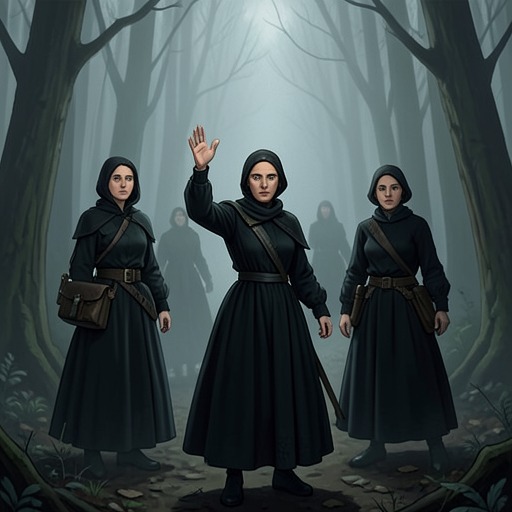
Arthur Holmwood
A History of the Vampire in Popular CultureArthur Holmwood is one of the human allies who oppose Count Dracula in Bram Stoker’s Dracula. Although the supplied evidence gives him no independent biography or complete personal arc, it places him at the center of the story’s final resistance: after Mina Murray has ingested Dracula’s blood, Holmwood joins Abraham Van Helsing, Jonathan Harker, and Quincey Morris in using the resulting connection to hunt the vampire back to his lair. His decisive significance lies in that transition from threatened individual to organized defender, helping turn Dracula’s private obsession into a collective conflict between the living and the undead.
Identity and Introduction
Arthur Holmwood belongs to the group of Victorian protagonists assembled against Dracula. The evidence presents him alongside Abraham Van Helsing, Jonathan Harker, and Quincey Morris as part of what is described as a Victorian version of a detective-adventure team. He is therefore defined less through a solitary encounter than through allegiance and action: Holmwood is one of the men who stand with Mina Murray after Dracula’s assault has altered her relationship to the vampire.
The wider literary tradition surrounding Holmwood is framed by the nineteenth-century construction of the modern vampire. Varney the Vampire introduced familiar traits such as sharpened, fang-like teeth, while Carmilla developed the image of the elegant nocturnal predator, emotionally and physically predatory but increasingly selective in its feeding. Dracula then gathered these tendencies into a fully rounded antagonist with deliberate plans and a moral character of his own. Holmwood’s role belongs to the human counterforce created by that development: he confronts not merely a folkloric revenant but a calculating personality whose violence is bound to desire, possession, and control.
Role in the Hunt for Count Dracula
Holmwood’s most important documented action occurs after Mina Murray drinks Dracula’s blood. In the 1992 screen adaptation Bram Stoker’s Dracula, the blood exchange creates a psychic and almost spiritual connection between Mina and the Count. Van Helsing, Harker, Quincey, and Holmwood exploit that connection to track Dracula to his home in the crumbling castle. Holmwood thus participates in a practical reversal: an act intended to bind Mina to Dracula becomes the means by which Dracula can be pursued.
The adaptation turns the hunters into a coordinated group rather than leaving the conflict as a simple contest between two men over one woman. Holmwood’s function is consequently collective and strategic. He is part of the human party that converts Mina’s compromised condition into knowledge, and knowledge into pursuit. The movement from blood, to psychic access, to physical tracking gives his role a clear causal shape even though the available evidence does not assign him a separate speech or individual combat scene.
This adaptation also intensifies the emotional logic of the hunt. Coppola’s version presents Dracula and Mina as reincarnated lovers whose attachment stretches across centuries, whereas the original novel treats Mina chiefly as the focus of Dracula’s misplaced obsession. Holmwood stands on the side of those who resist that fatal lovers’ narrative. His presence helps preserve the opposing claims of friendship, human loyalty, and protection against Dracula’s demand that Mina be absorbed into his eternal existence.
Relationships and Conflict
Holmwood’s documented relationships are primarily defined by alliance. He works with Abraham Van Helsing, whose authority organizes the campaign; with Jonathan Harker, whose experience of Dracula supplies the group with intimate knowledge of the enemy; with Quincey Morris, another active member of the hunting party; and with Mina Murray, whose blood tie to Dracula becomes central to the group’s strategy. The evidence does not establish a detailed private history for Holmwood with any of these figures, so his characterization remains grounded in shared purpose rather than personal exposition.
His conflict with Dracula is both physical and ideological. Dracula treats blood as a medium of possession and continuity, inviting Mina into eternal life and attempting to make her part of his cursed condition. Holmwood belongs to the human resistance that refuses this transformation. The hunters’ use of Mina’s connection does not erase the danger imposed on her, but it prevents Dracula from controlling the meaning of that connection. What Dracula creates as a bond of domination becomes, in the hands of his enemies, a vulnerability.
The blood-tie motif also links Holmwood’s role to a later adaptation, the 2020 BBC version, in which Dracula takes Sister Agatha, also known as Zoe Van Helsing, inside himself physically and mentally by drinking her blood. In both versions, blood crosses the boundary between predator and victim, but the direction of power differs. The 1992 film makes Mina’s altered state useful to the hunters, while the BBC story emphasizes Dracula’s ability to carry an opponent within himself. Holmwood’s significance is clearest against this contrast: he is part of a human network that answers supernatural intimacy with cooperation.
Adaptation and Narrative Significance
Arthur Holmwood demonstrates how adaptations can preserve a character’s narrative function while changing the surrounding emotional architecture. The screen version is far from a faithful rendering of Stoker’s original vision. It adds the prequel material that identifies Mina with Dracula’s lost love and pushes the fated-lovers theme to its extreme. Within that revision, Holmwood remains attached to the opposing plot of rescue and pursuit. He helps keep the story from becoming only a romance between Dracula and Mina by locating their encounter within a larger struggle.
His relative lack of independently supplied detail is itself revealing. Unlike Dracula, Mina Murray, or Abraham Van Helsing, Holmwood is not presented here as a fully elaborated psychological center. He functions as an ally whose importance comes from the group’s coordinated action. In the narrative economy of the vampire hunt, this makes him a threshold figure between private melodrama and public danger: Dracula’s desire may begin as an intimate assault, but Holmwood’s alliance with the other hunters exposes its wider consequences.
That function also connects him to the changing history of vampire representation. Early stories increasingly established the vampire as a night creature, while later literature and film allowed vampires to become sympathetic, elegant, erotic, comic, openly social, or even potentially benevolent. Arthur Holmwood belongs to the older defensive model, in which the vampire is an external threat and human solidarity is the necessary answer. Yet the adaptation’s emotional complications prevent the conflict from remaining simple. Mina is not merely an untouched victim, Dracula is not merely a faceless monster, and Holmwood’s resistance takes place within a story where love, blood, memory, and violence have become inseparable.